Smart process control halves nitrous oxide emissions at Panheel WWTP
Authors: Michel Mulders (Haskoning), Saskia Hanneman (WL), Okker van Batenburg (Haskoning), Edward van Dijk (Haskoning), Mario Pronk (TUD)
Three years of intensive research show that targeted process control reduces nitrous oxide (N2O) emissions by 45% while maintaining effluent quality.
Waterschap Limburg’s ambition is clear: to operate in a fully climate-neutral manner. Since nitrous oxide emissions constitute a substantial portion of a water authority's total greenhouse gas emissions, reduction is crucial. To gain control over this process, the water authority launched a multi-year research project at WWTP Panheel. The goal was twofold: to gain insight into the plant’s emissions and, more importantly, to discover which "knobs" could be turned to minimize these emissions.
The need for long-term insight
While extensive research on nitrous oxide emissions has been conducted worldwide, these studies have focused primarily on conventional activated sludge systems. Knowledge regarding emissions in full-scale granular sludge technology was, until recently, limited. At WWTP Epe, a two-week study measured an average emission factor of 0.7%. At WWTP Dinxperlo, measurements over a longer period (August to March) determined an emission factor of 0.33%.
What was missing was a dataset spanning multiple years to provide insight into long-term effects like seasonal effects. From this insight the next steps could be taken to reduce the emission of N2O. WWTP Panheel fills this gap as the first site where multi-years of full-scale research has been performed on a treatment plant utilizing granular sludge technology.
A unique living lab
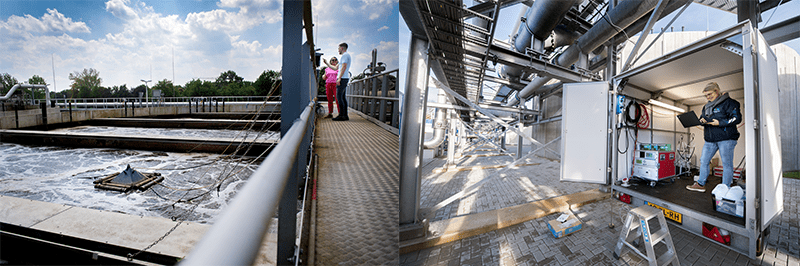
WWTP Panheel was the perfect location for this research. The plant is a Nereda® installation built according to the modular Verdygo® concept, featuring two identical reactors. This made the facility highly suitable for comparative field research: one reactor operated as a reference using standard settings, while the second reactor served as a test environment for various new control strategies. Figure 1 shows an overview of the experimental setup used to quantify nitrous oxide emissions.
Summer peaks instead of Spring peaks
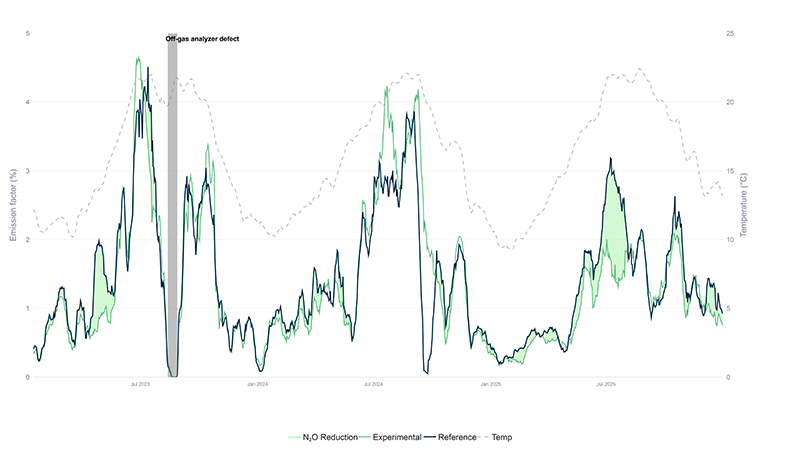
Monitoring quickly yielded a surprising insight. While conventional activated sludge systems often experience emission peaks in the spring, the granular sludge system in Panheel showed higher values in the summer. This seasonal pattern confirmed that granular sludge technology requires its own specific approach. Although it’s not yet clear if the observed summer peak in Panheel is specific to the location or to the granular sludge technology.
The key: integrated process control
Six different strategies were tested in the trial reactor. Table 1 provides an overview of all measures and their impact on effluent quality and the emission factor.
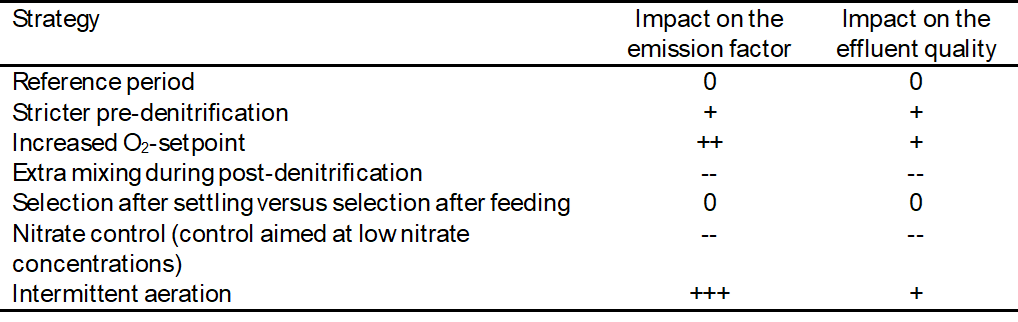
The common thread was the search for a better balance in the nitrogen cycle. The final reduction of over 45% was achieved through three key insights:
- Focus on Pre-denitrification
In a standard Nereda cycle, the nitrification period begins after pre-denitrification. If nitrate is still present at that moment, it can lead to incomplete denitrification, a known trigger for N2O production. The new strategy aims to keep nitrate concentrations as low as possible during pre-denitrification, nipping this emission source in the bud. - Intensive Main Aeration
A second focus point was oxygen input. By steering for a higher dissolved oxygen (DO) level, the blowers operated at higher power for longer. This shortened the total aeration phase because ammonium was consumed faster, which had a direct mitigating effect on emission factors. An added benefit: besides lower N2O emissions, effluent quality also improved due to this more robust process management. - Smart Intermittent Aeration
The greatest gains were achieved with the introduction of a smart, intermittent aeration strategy. During this test period, aerated phases were alternated with short anoxic blocks. The idea is to make clever use of the biochemistry of the nitrogen cycle. By incorporating anoxic pauses, intermediates of nitrification, such as nitrous oxide or nitrite, are immediately used as a substrate for denitrification. This prevents the accumulation of products that would otherwise be released as nitrous oxide. Combining these insights allowed the specific summer peak to be flattened by 45%.
To substantiate the effectiveness of these measures, the improved settings were also applied to the reference reactor. Emissions in that reactor immediately dropped to the same low level, proving that the reduction is a direct result of the improved process control.
Quality remains guaranteed
A strict prerequisite for the water authority was effluent quality; climate gains must not come at the expense of clean water. The results in Panheel show that both goals were met. Throughout the study, concentrations remained well within standards, with averages of 6.7 mg/l total nitrogen (TN) and 0.5 mg/l total phosphorus (TP). In practice, N2O emission reduction and high purification efficiency go hand in hand.
From pilot to standard
For Waterschap Limburg, these results are a reason to push forward. The knowledge gained is being directly converted into operational success, with the ambition to roll out this control strategy to all Nereda installations in the region.
At the same time, the learning process continues. To better understand the fundamental mechanisms behind nitrous oxide formation in granular sludge, a broad follow-up project has been launched. This project is a collaboration between the water authorities, STOWA, TU Delft, and Haskoning. Within this track, of which WWTP Panheel remains a part, two PhD students will further unravel the relationship between process conditions and emissions.
In this way, Waterschap Limburg is working with the sector toward a climate-neutral water chain, step by step and backed by science.
Start reducing nitrous oxide emissions today!